
Do We Still Need 3D Modelling in the Age of Artificial Intelligence?
A 3D model does more than show what an object will look like. It helps us understand whether that object can actually exist.
Introduction
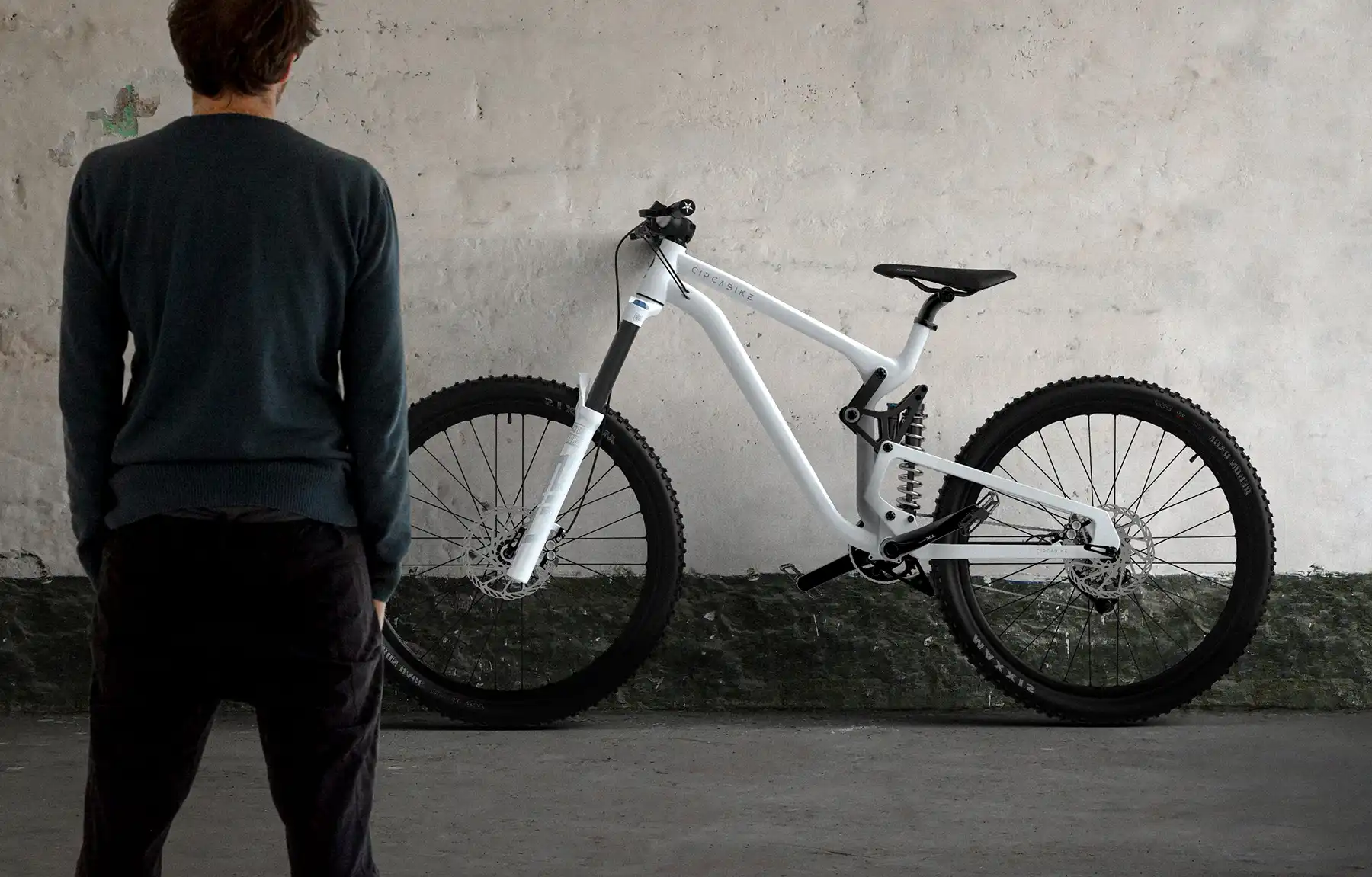
A render showing the bicycle designed for CircaBike.
Today we can generate extremely realistic images in just a few seconds, explore different forms and imagine products that, until recently, would have required hours of work.
But an image is not a design project. Before reaching the final render of a product, there are geometries to check, proportions to control, components to bring together and constraints that need to be respected.
This is precisely why a 3D model is created: to verify what we have designed before it is produced.
When working on a complex product, the time spent in front of a computer is only one part of the process. Before that stage come weeks of observation, reasoning, adjustments and verification.
This is the part of the work that is often invisible.
And perhaps this is exactly where 3D modelling still makes sense.
Contents
2. A 3D model is a tool for verification
4. Design time is not the same as time spent in front of a screen
1. Geometry comes before 3D
A 3D model does not appear out of nowhere. Before building surfaces and defining volumes, we need to establish the conditions the design has to meet.
In the case of a mountain bike frame, these conditions are particularly evident: wheelbase, angles, pivot points, clearances, component positions and suspension movement all have to work together in a precise balance.
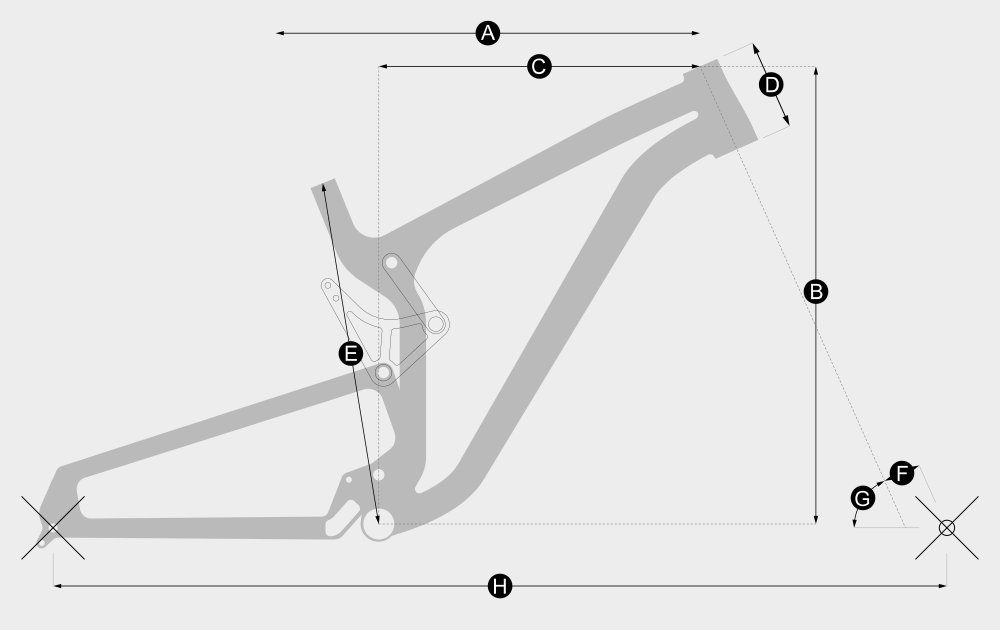
Before the 3D model comes geometry: a map of dimensions and constraints on which the design can be developed and verified.
A. Effective Top Tube Length
B. Stack
C. Reach
D. Head Tube Length
E. Frame Size
F. Offset
G. Head Tube Angle
H. Wheelbase
This is why the design process often starts with a two-dimensional representation.
It is not yet the product. It is more like a map of the project: a basis for comparing different possibilities and understanding which geometries can work before turning them into a three-dimensional model. The 3D model comes later.
2. A 3D model is a tool for verification
It is easy to think of 3D as the tool used to create the final image of a product. In reality, that is only one of its possibilities. A 3D model is primarily a tool for verification.
We can check proportions, measure distances, compare geometries, verify clearances and observe how the different parts of a project relate to one another.
We can modify a solution and immediately see what changes. And, most importantly, we can identify an error before that error becomes a real-world problem.
In the frame project, every element has to work together with the others. A change in geometry can affect the position of a component, the movement of the suspension or the structure of the frame itself. The 3D model makes it possible to see these relationships before the product exists. It is not a photograph of the object. It is a tool for control and verification.
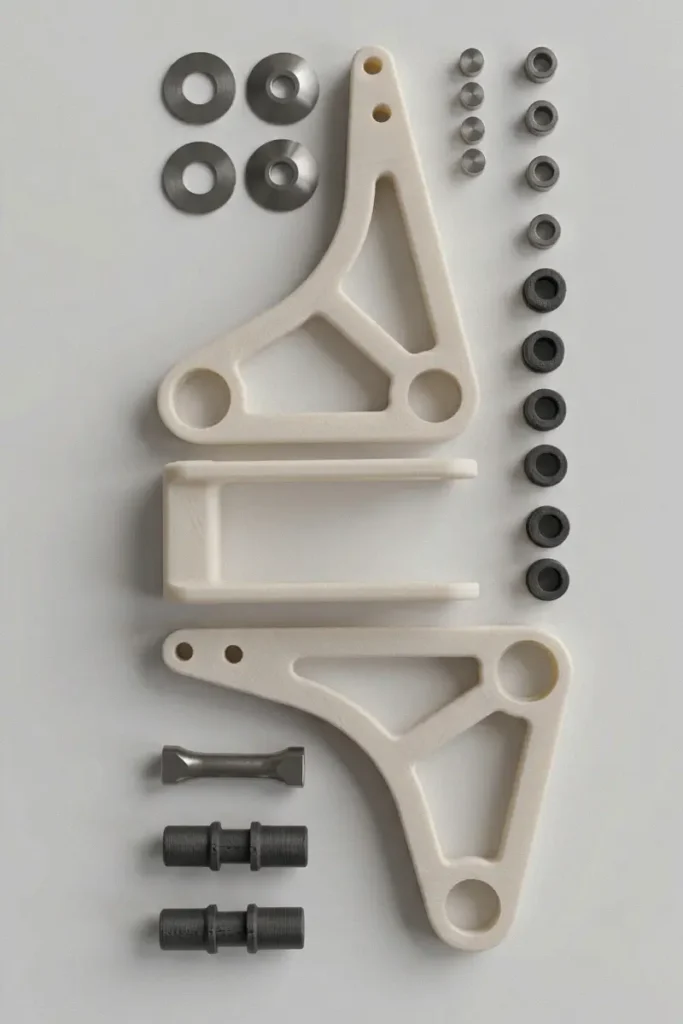
3D-printed models of the linkage and suspension components used to verify geometry and relationships between the parts.
3. The part you don’t see
When a project reaches its final form, everything often looks much simpler than it really was. The model is clean. The surfaces are refined. The render shows a finished product. But behind that simplicity are tests, changes, mistakes and decisions.
A model may be rebuilt many times. A geometry may look correct and turn out to be wrong when it is brought into relation with another part. A seemingly simple solution may require hours of verification before it can really be considered final. This is a part of the work that rarely appears in the final image.
And yet, this is exactly where the design takes shape.
The hours spent in front of the computer are not simply about drawing an object more accurately. They are about understanding whether what we imagined can actually work.
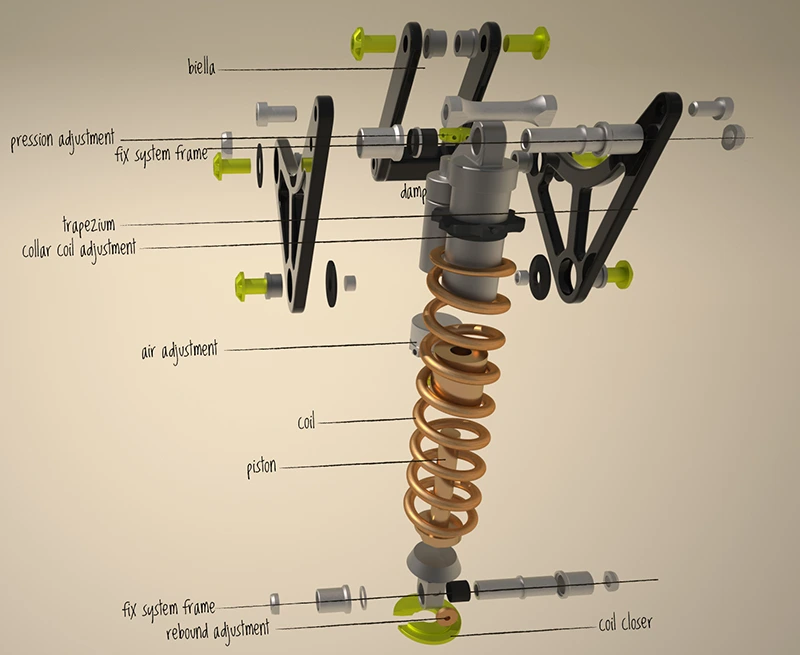
The exploded view makes it possible to read the suspension system and the relationships between its components.
4. Design time is not the same as time spent in front of a screen
One of the most difficult things to explain about design is that the time needed to develop something does not correspond to the time spent in front of a computer.
A 3D model may take only a few hours to build.
But understanding what to model, how to model it and why that solution is the right one can take weeks.
Meanwhile, the project continues even when the computer is switched off.
You observe.
You compare.
You make assumptions.
You go back.
You eliminate possibilities.
Sometimes an idea remains in your mind for days before it finds a concrete form.
By the time the software is finally opened, many of these decisions have already been made.
That is why the final result can appear so quick. But the speed of execution does not reveal the amount of thinking that came before it.
Rotating the 3D model makes it possible to verify the frame from different angles before its final definition.
5. Software is a tool, not the design
Rhino, SolidWorks, Blender, Cinema 4D or any other software can be extraordinarily powerful tools.
But none of them decides what needs to be designed.
Software allows us to build complex geometries, modify them, measure them and represent them with great precision.
The decision about which geometry to build, however, remains a design decision.
That is why I don’t believe the value of a project can be measured by the software used or by the complexity of the model.
A good 3D model is not the one that contains the most detail.
It is the one that contains the information needed to properly verify and develop the design.
6. So what about AI?
Artificial intelligence is rapidly changing the way we create images, explore possibilities and communicate ideas.
And that is interesting.
We can generate forms, environments and variations in just a few seconds that would previously have required much more time.
But precisely because of this, it becomes even more important to distinguish an image from a design project.
AI can help explore a possibility.
It can help visualise it.
It can even suggest a direction we had not considered.
But it does not eliminate the need to understand constraints, recognise the relationships between different parts and verify whether what we have imagined can actually be built.
AI can radically change the tools we use to design.
It does not eliminate the need to know what we are designing.
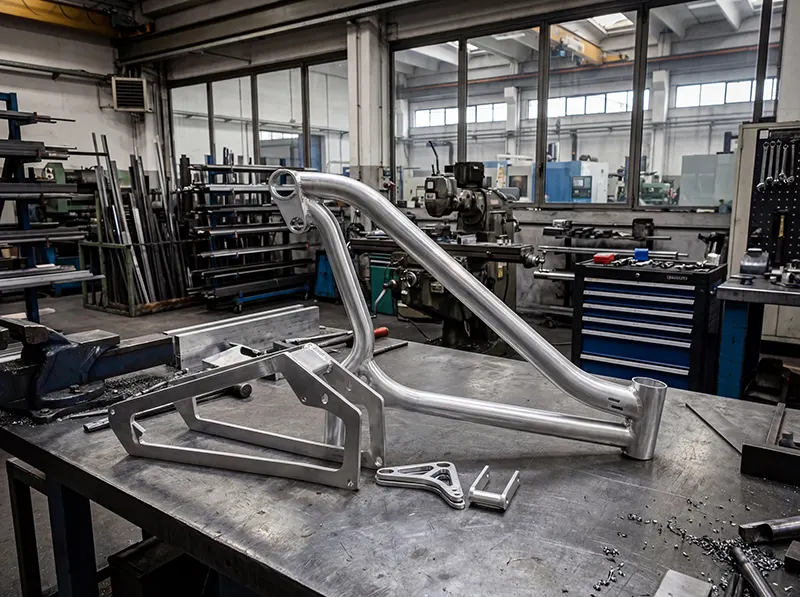
AI-generated image of the frame.
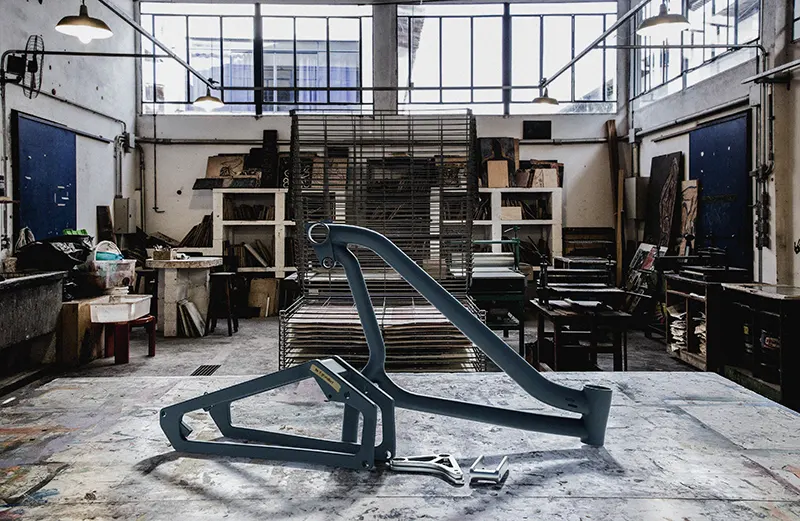
Render of the frame created in KeyShot.
7. From 3D model to product
In the frame project, the 3D model was the point at which all the previous checks and decisions came together in a concrete form.
The defined geometries, components, suspension system and structural constraints were integrated into a single system, then verified and progressively modified until reaching the final configuration.
Only at that point could the model become something more than a representation.
It became the reference for preparing the data required for production.
The final render shows the result.
The 3D model, on the other hand, tells the story of everything that had to be verified to get there.
8. Tools evolve. Design doesn’t
Artificial intelligence will continue to change the tools we use to imagine, develop and communicate products.
It will probably make them faster.
It may make some stages of the process much simpler.
But design will continue to start from the same point:
an idea to understand, constraints to respect and a reality to verify.
The designer’s task is not simply to imagine something that does not yet exist.
It is to turn that idea into something that can actually exist.
From research to model development
The 360 concept reveals the journey that transforms an intuition into a project